
Nihonbashi — A Bite of Hokusai’s Perspective
When You Open the Box, Tokyo Moves One Station Closer
Opening a Moncha box is an invitation — not to the Tokyo of guidebooks, but to the quieter city that lives just beside everyday life. When the last bite is gone, what lingers is more than the taste of sweets. It might be the faint echo of footsteps on Nihonbashi’s stone pavement, or the breeze moving slowly across the river. By the time you reach the end of this page, your own story may have moved forward by a small scene, together with the city of Tokyo.
The theme of this journey is Tokyo, Connected. From station to station. From history to daily life. Let’s follow the path together with Samurai Moncha.
Samurai Moncha Route: Tokyo, Connected
Nezu (where myth begins) → Kanda (the city’s guardian) → Tokyo & Nihonbashi (Station & Crossroads) → Shibuya (neon) → Shinjuku (gateway) → Mt. Takao (mountain faith)
This time, our journey leads us to Nihonbashi, the place where Tokyo begins.
Travel Memory: Nihonbashi
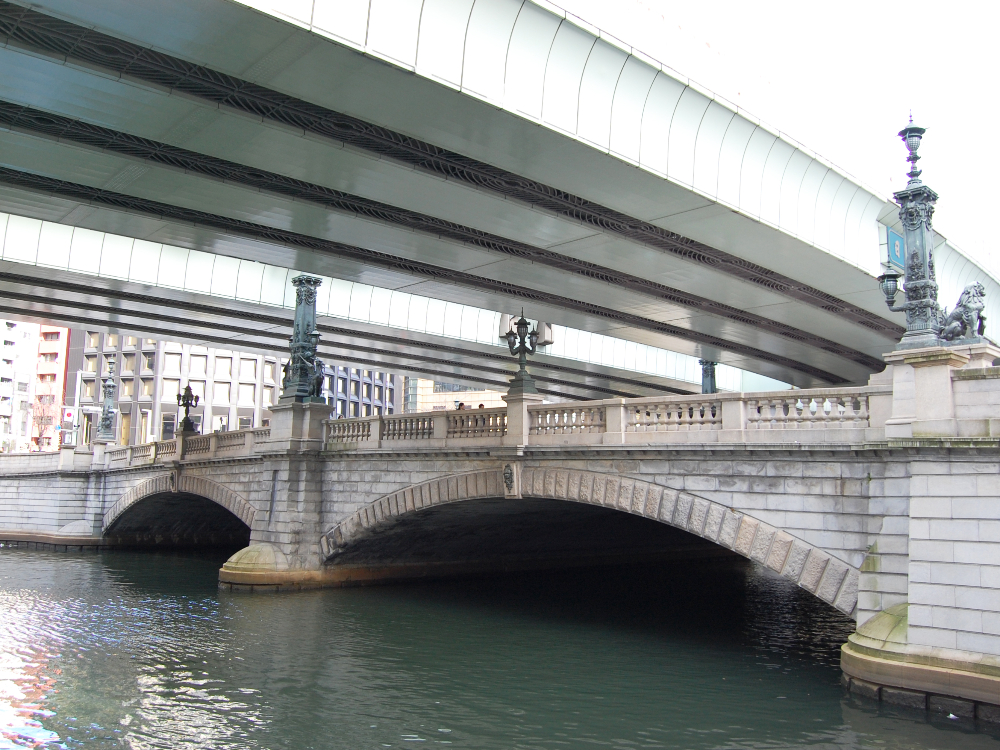
Nihonbashi has long been considered the historical starting point of Tokyo. During the Edo period, the bridge marked the origin of the Five Routes, the highways that connected Edo to the rest of Japan.
Quick note — What were the Five Routes?
They were the official roads established by the Tokugawa shogunate to manage travel, trade, and communication across the country. In many ways, they functioned as the national highways of Edo-era Japan.
Walk across the stone pavement of Nihonbashi and the city begins to move quietly around you. Office workers pass with steady, practiced strides. Old shops lift their shutters for the day. If you pause at the railing and look down toward the river, the past feels close.
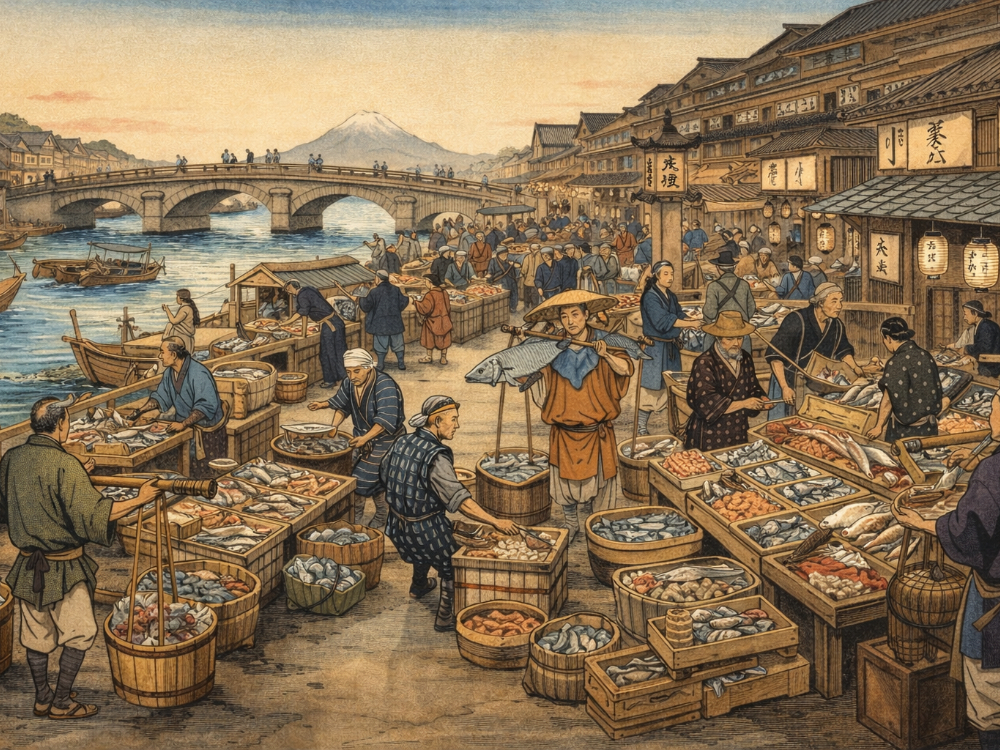
This was once the site of a bustling fish market. Travelers crossed the bridge while gazing toward Mount Fuji in the distance. Even now, that sense of departure still lingers in the air.
And there was one artist who captured the scenery of Edo with both curiosity and playfulness.
Hokusai — The Artist Who Turned Everyday Life into Art
Katsushika Hokusai, the master of ukiyo-e, worked during the Edo period and remains one of Japan’s most internationally recognized artists. His most famous series is Thirty-Six Views of Mount Fuji, which includes the iconic image of towering waves with Mount Fuji rising in the distance — The Great Wave off Kanagawa.
What makes Hokusai’s work remarkable is his perspective. He did not simply paint landscapes; he revealed them from unexpected angles. From a bridge. From a street corner. From the surface of a river.
To bring that playful shift of perspective into everyday life, the Moncha box includes a furoshiki cloth printed with Hokusai’s Red Fuji (Fine Wind, Clear Morning).
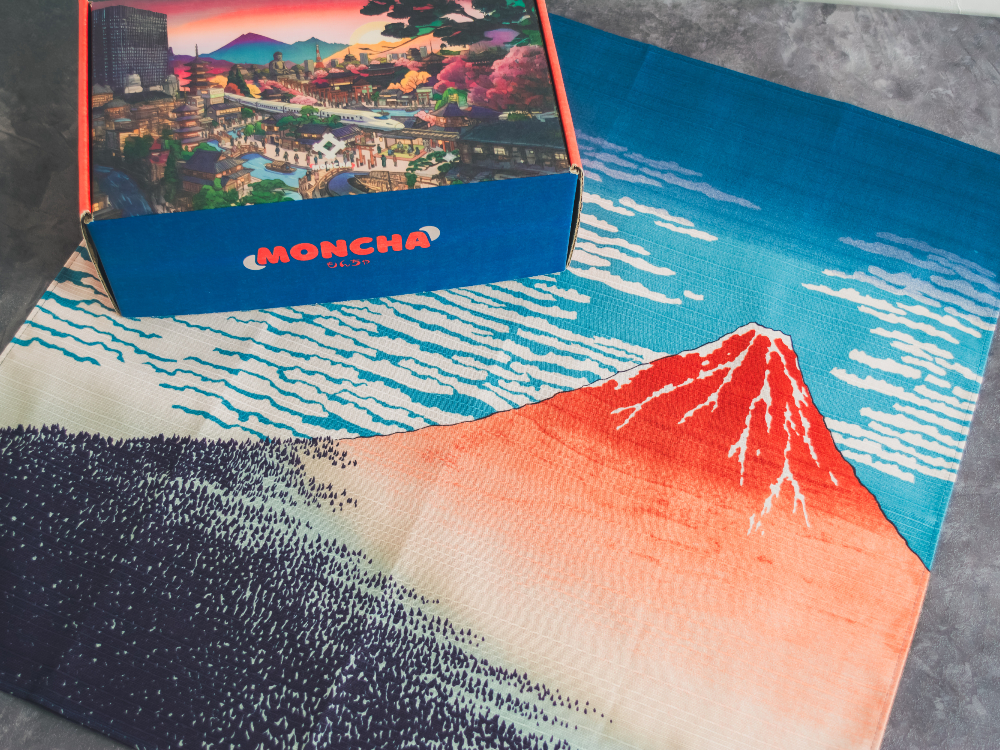
A Moncha box paired with a furoshiki cloth featuring Hokusai’s Red Fuji (Fine Wind, Clear Morning) — bringing a playful piece of Japanese art into everyday life.
Wearing the Perspective — Bringing the Journey Home
The furoshiki can wrap a gift, slip into a bag as a book cover, or accompany you on a walk through Nihonbashi. Its vivid Fuji recalls the colors Hokusai once imagined. Holding it feels a little like tying a piece of Tokyo’s historic landscape into your daily life and carrying it home.
Hokusai’s perspective lives not only in the sweets, but also in this simple piece of cloth.
A Discovery Along the Journey: Hokusai Ippuku
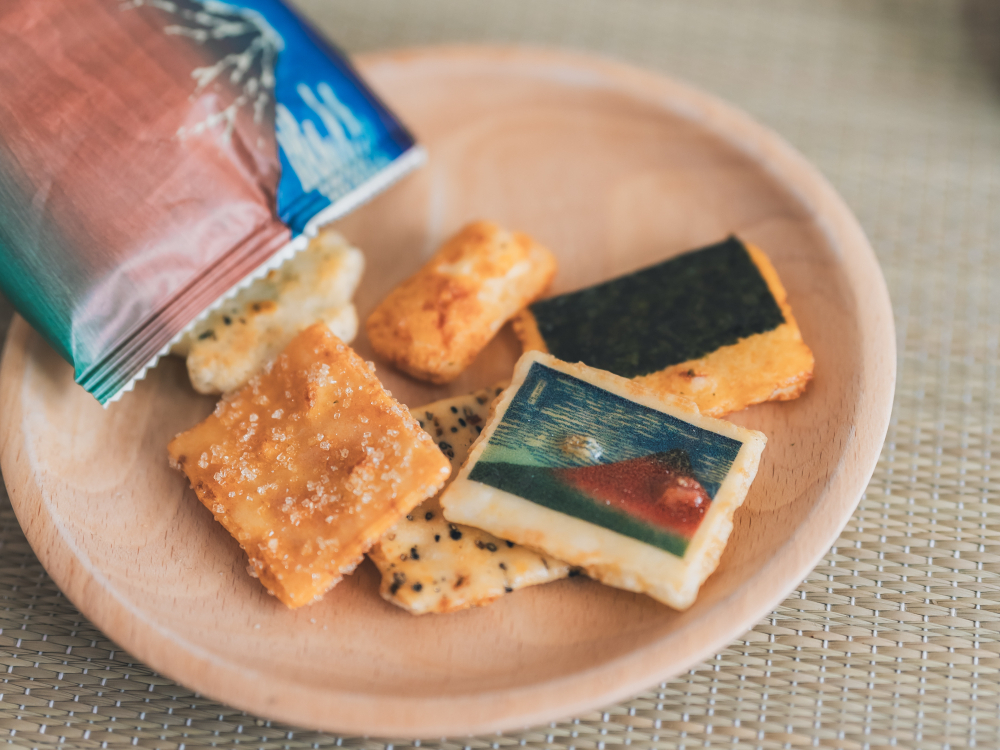
Sitting on a terrace along the Nihonbashi River and watching the water drift past, a thought appears: did Hokusai ever pause here to watch the changing sky?
During that quiet moment I discovered a small snack that seemed perfectly suited to the scene — Hokusai Ippuku.
Ippuku means taking a brief pause for tea, a moment to exhale and reset.
Inspired by Hokusai’s Thirty-Six Views of Mount Fuji, this rice cracker carries the aroma of roasted rice along with soy sauce, seaweed, and black sesame. The flavor feels almost like a condensed landscape, a reminder to pause and notice the world again.
Just as Hokusai once paused to observe the scenery of Edo, this small snack invites you to do the same — a gentle reset of perspective.
Taste Notes
Appearance
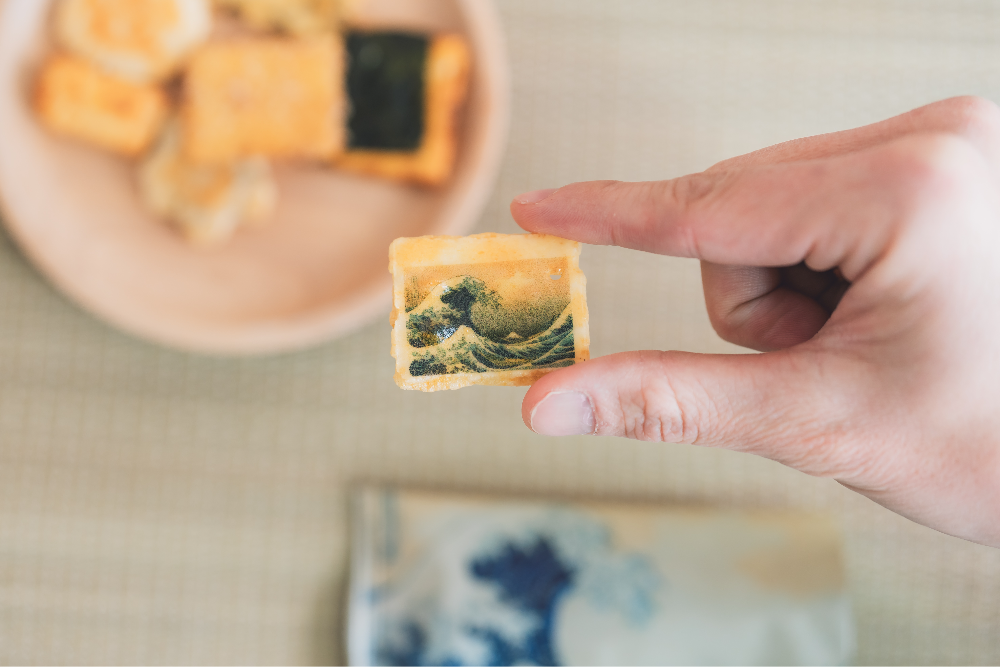
Inside the package are bite-sized rice crackers with different shapes and textures. One piece stands out in particular: printed directly onto the cracker is a miniature reproduction of Hokusai’s ukiyo-e artwork, the same design seen on the package itself. Holding it in your palm feels like holding a tiny work of art — almost too beautiful to eat. It is one of Moncha’s quiet surprises: a chance to experience Hokusai with all five senses.
Aroma
When the package opens, the warm fragrance of roasted rice appears first.
Texture
Crisp and light, with a satisfying crunch that lingers.
Flavor
The taste unfolds gradually: savory soy sauce, aromatic seaweed, and the nutty depth of black sesame. Between sweet snacks, one bite of this cracker gently resets the palate.
How Hokusai Teaches Us to See Tokyo
Hokusai’s art is not only about landscapes. It is about how we choose to look at them. From a bridge. From a boat. From a quiet corner of the city.
The same place becomes a different scene depending on the viewpoint.
Tokyo works the same way. Walk from one station to the next and the scenery shifts little by little. Pause for a moment, then continue walking. The city unfolds in that rhythm.
How to Enjoy It
A Small Edo-Style Break Between Sweets
Hokusai Ippuku works beautifully as a small pause between sweet wagashi. After a bite of dorayaki or yokan, try one rice cracker. The roasted rice flavor gently settles the sweetness.
Sweet → Rice cracker → Sweet.
That small rhythm makes the experience feel lighter and more balanced.
Recommended drink pairings
Green tea — highlights the savory soy sauce notes
Hojicha — deepens the roasted aroma
Black coffee — surprisingly good with the fragrance of rice
A brief savory pause after sweetness. One of the quiet pleasures hidden inside the Moncha box.
From the Starting Point of Nihonbashi to Everyday Life
What this small rice cracker carries is Hokusai’s playful way of seeing the world. May the tiny ippuku inside your Moncha box shift the scenery of your day, even if only slightly.
Next Station: Tokyo, Connected Continues
The journey of Samurai Moncha continues.
Next station: Tokyo Station (hub) → Nihonbashi
Tokyo, Connected — the journey goes on.
FAQ
What is Hokusai Ippuku?
Hokusai Ippuku is an assortment of rice crackers inspired by Hokusai’s Thirty-Six Views of Mount Fuji. The crackers combine roasted rice with soy sauce, seaweed, and sesame for a savory, aromatic flavor.
What are the highlights of Nihonbashi?
The bridge itself features lion and kirin statues and marks the historic starting point of the Five Routes. The area is also home to long-established shops and historic architecture where Edo history blends naturally with modern Tokyo.
What is the connection between Hokusai and Nihonbashi?
Hokusai depicted “Edo Nihonbashi” in his series Thirty-Six Views of Mount Fuji. In the Edo period, Mount Fuji could often be seen in the distance from Nihonbashi, inspiring many artists, including Hokusai.